
“A child without education is like a bird without wings” – A Tibetan Proverb
My journey with Vidyadhan started in 2019. Having served in the government for more than 25 years, it was a big change from working in the security domain to working with bright eyed students. To introduce Vidyadhan: it is a higher education scholarship program of the Shibulal Family Philanthropic Initiatives (SFPI), with the aim to provide scholarships (class 11 onwards till graduation) to students from economically disadvantaged families.
The conviction that quality education is the cornerstone of development in society, led Kumari Shibulal and S. D. Shibulal (co-founder and ex-CEO, Infosys) to set up the Sarojini Damodaran Foundation (SDF; as a part of the SFPI)in 1999. Breaking the poverty cycle and transforming lives through focused interventions have been the guiding principles of their philanthropic journey. This year, SDF and Vidyadhan turn 25.
Every year, after the class 10 results are out, Vidyadhan issues notifications state wise informing students about the opening of its scholarship application process. As per the notification, students with a certain specified percentage in class 10 (varies from state to state, with a 10% lower threshold for students with disability), and enrolled in class 11 can apply for the scholarship provided their parents’ income is below Rs 2 lakh annually. The students can apply online through the Vidyadhan website: http://www.vidyadhan.org/. In case of any difficulty during application, students can call a dedicated Help Desk number: 9663517131. The subsequent selection process for the scholarship includes an online test, followed by an interview, and house visit.
Experience has shown that while financial support will enable and ease the students’ educational journey, to strengthen their confidence and self-belief, career guidance and soft skills training is needed. This is provided by Vidyadhan through programs which are organised for the students, in both offline and online formats, to help them succeed in their lives and attain their true potential.
The WHY of Vidyadhan derives from the ground reality that India suffers a markedly high dropout rate at the class 11 level, thereby precluding a higher level of human capital formation. The student enrolment in class 11 drops significantly as compared to class 10, and student enrolment in college further declines by about half as compared to the Intermediate or Plus-Two level, as several studies indicate. Vidyadhan is, therefore, a well-considered program to bolster the low GER (student enrolment as a proportion of the corresponding eligible age group in a given year) in higher education. It is also a transparent, scalable, tech-platform that is being used, besides the Vidyadhan team, by its corporate and individual partners.
Then arise the related questions of actual learning and employability. After graduation what? It is a difficult question to address in a situation where the employment scenario is not too encouraging. Vidyadhan attempts to address the concerns about learning and employability by trying to strengthen the students’ skills that would hold them in good stead. This, in turn, entails that the program is ‘high-touch’ with our State Coordinators being in regular touch with the students, being always accessible, and organising annual mentoring camps during the summer break in the academic cycle. In the last few years, Vidyadhan’s corporate partners and individual sponsors have become more actively involved in the mentoring process enriching it and opening new avenues for the students. So, there has been an enhancement in the mentoring framework and quality over the years. Some corporate partners like UST, Neeyamo, Flex, Fanuc India, and LTIMindtree are also providing internship opportunities to students.
Besides directly impacting the GER, there are other reasons too that provide a macroeconomic framework for intervention in the higher education space. Vidyadhan is indeed a small effort given the needs of our vast nation, however, it is important to place the program and other such initiatives in a larger framework.
Higher education is an area that has immense potential to lead to positive externalities. To borrow from the extraordinary book on public policy ‘In Service of the Republic’ by Vijay Kelkar and Ajay Shah: “A university that triggers off a hotbed of entrepreneurship in its neighbourhood is inducing a positive externality. It imposes beneficial impacts upon nearby households, without their consent.” When a Vidyadhan girl student from a remote village in Karnataka becomes a doctor and becomes a role model for other girls in her village and the neighbouring villages, it induces a positive dynamic in the area. Similarly, enhancement of skills induces positive externalities, and though Vidyadhan is not what could be termed a skilling program, it supports students some of whom pursue courses like nursing and pharmacology. (“Externalities are situations where persons impact upon each other in ways that are not intermediated through voluntary agreements between these persons, where people impact upon each other in ways that were not negotiated. Consider a factory that emits pollution upon residents without their consent. This pollution is an example of a negative externality.”) (pp 9-10, In Service of the Republic).
To build a case for such an intervention in the higher education space, it would also be useful to look at it in a general equilibrium framework. It is not easy to see the overall impact of a program like Vidyadhan on an economy-wide scale. However, if we visualize it intuitively it appears that such an intervention implies an increase in aggregate demand for higher education in the country as it supports those students who might not have been able to be part of the higher education system in India otherwise. It simultaneously also means broadening the talent pool in higher education by including students who might have dropped out after class 10, and deepening it as the students being supported are meritorious, who have performed well academically under difficult circumstances. Besides, of course, the initiative attempts to promote equity in an otherwise income-skewed higher education domain and, thereby in society. (pp 82-85, In Service of the Republic)
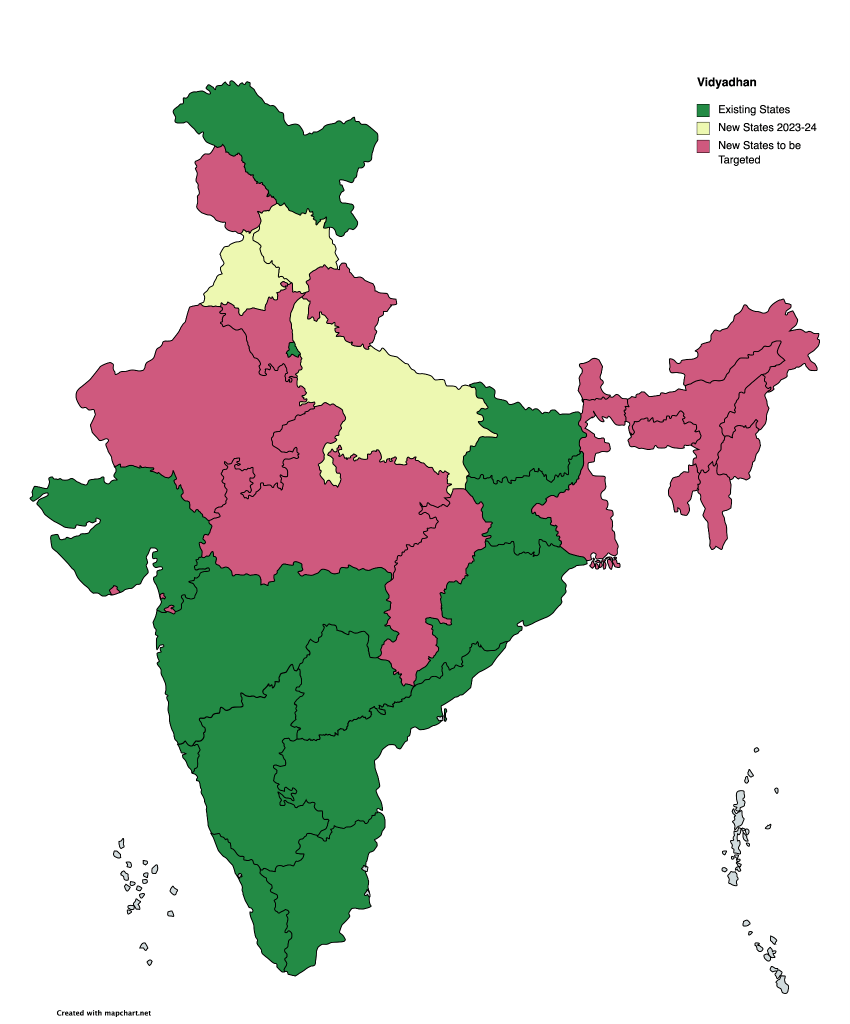
Today, the Vidyadhan scholarship has a presence in 17 Indian states/UTs (Kerala, Karnataka, Tamil Nadu, Puducherry, Andhra Pradesh, Telangana, Maharashtra, Goa, Gujarat, Odisha, Delhi, Ladakh, Bihar, Jharkhand, Uttar Pradesh, Himachal Pradesh, and Punjab), with three states – Uttar Pradesh, Himachal Pradesh, and Punjab – being added in 2023-24. In 2022-23, the states of Bihar and Jharkhand were covered under the program, which aims to scale up to 100,000 scholarships, as well as cover all the states/UTs in India in the coming years.
Impact
Vidyadhan has been making an impact on multiple fronts. Vidyadhan girl students have been breaking gender stereotypes by being providers for the family. A Vidyadhan impact assessment by IIM-Kozhikode a few years back showed that the average first year salary of the students was 3 times the scholarship amount; and in nearly all instances the families also emerged out of poverty within 2 years of the students getting employed. Vidyadhan alumni are today working as doctors; as engineers with reputed firms like TCS, Infosys, Wipro, Volvo, Oracle, ICICI, Cognizant, Accenture, and Bosch; Chartered Accountants; agricultural scientists; and government servants including in the defence forces.
As assessed by an independent institution (IIM – Kozhikode), the program’s impact has been multi – dimensional. Most importantly, it has enabled entire families to break out of the cycle of poverty and for students to emerge as role models in their communities.
Having briefly looked at the broader framework in which Vidyadhan operates, it is important to look at Vidyadhan as a technology platform. A platform that enables the program to run in an effective and transparent manner. A platform that is easily scalable. A platform that is customisable and ready to adapt from state to state (more about it in the next para). And, because of all the above, a platform that can be easily used by other economic entities, both corporates and individuals, to join as external sponsors/ partners, and be part of a common endeavour.
India is a vast and diverse country and a continental economy. As Lant Pritchet says, the ratio of the richest to the poorest parts of India is much like the ratio of the richest parts of Latin America divided by the poorest parts of Africa. “There is also heterogeneity of political and social preferences, where the south and the west are making more progress on social issues such as the agency of women.” (Pg 127, In Service of the Republic). The most salient problems vary from one place to another, and the most effective solution varies from one place to another. There are no silver bullets. In implementing Vidyadhan across seventeen states, we have had to adapt to changed conditions in each state and even within states. As Deng Xiaoping put it, “cross the river by feeling the stones.”
Our vision, in the next decade, is to take the program to all the states and UTs of the country from the current seventeen states/ UTs and reach a figure of one lakh scholarships from the current level of around 33,200 scholarships. When we look at the main challenge ahead for Vidyadhan – to reach out to a growing number of students from economically disadvantaged families, spread across the country – it looms large, almost insurmountable. The only way forward is by expanding the partnerships, by reaching out to more and more people and entities to join in the journey. To turn it into a movement.
With this in mind, a new model of the programme named “Each One, Teach One” was launched in 2015, to make this programme more scalable and self-sustainable. ‘Each One, Teach One’ allows each one of us to fulfil our moral responsibility to give back to society and to make higher education accessible to all in the most transparent manner. Any individual interested in sponsoring the higher education of a student can do so with utmost transparency and without administrative hassle. And, they can choose one student or many. Interestingly, the Vidyadhan alumni have also been coming forward and committing to sponsor Vidyadhan scholars, once they themselves become self-reliant. A kind of ‘pay it forward’ that adds a self-sustaining dimension to the program.
As Vidyadhan was scaled, the importance of forging partnerships with individuals and corporates was increasingly realized. Today, thousands of Vidyadhan students are being sponsored either by individual partners or corporate partners. And these numbers are growing every year. The partnerships, however, are not only about sponsorships, these also strengthen mentorship and create opportunities for employment.
Today, the total number of students receiving scholarships annually has increased to more than 7700, while the cumulative number of scholarships provided since inception has crossed 41,000. Geographically, too, the program has expanded, with the number of states/UTs covered under Vidyadhan rising from 1 in 1999 to 17 in 2023-24.
As of 2023-24, Vidyadhan has helped 3225 students complete their higher education and become productive citizens of the country. The alumni comprise – 225 doctors, 958 engineers, and 450+ students in professional courses (nursing, pharma, agriculture etc.).
This growth has been fuelled by a constant focus on its vision to transform lives through higher education, leveraging technology to run the operations efficiently, building a partnership eco system through its highly transparent zero admin cost sponsorship model, and a committed and professional team. The journey continues.
***


Dear Pankaj’s Ji,
<
div> You’ve very well explained the concept behind establishment of Vidyadhan and its outreach
LikeLiked by 1 person
Thank you very much! Regards,
LikeLike
Comprehensive and Heart Warming 👍🏽 Best wishes to Vidhtadhan team!!
LikeLiked by 1 person