
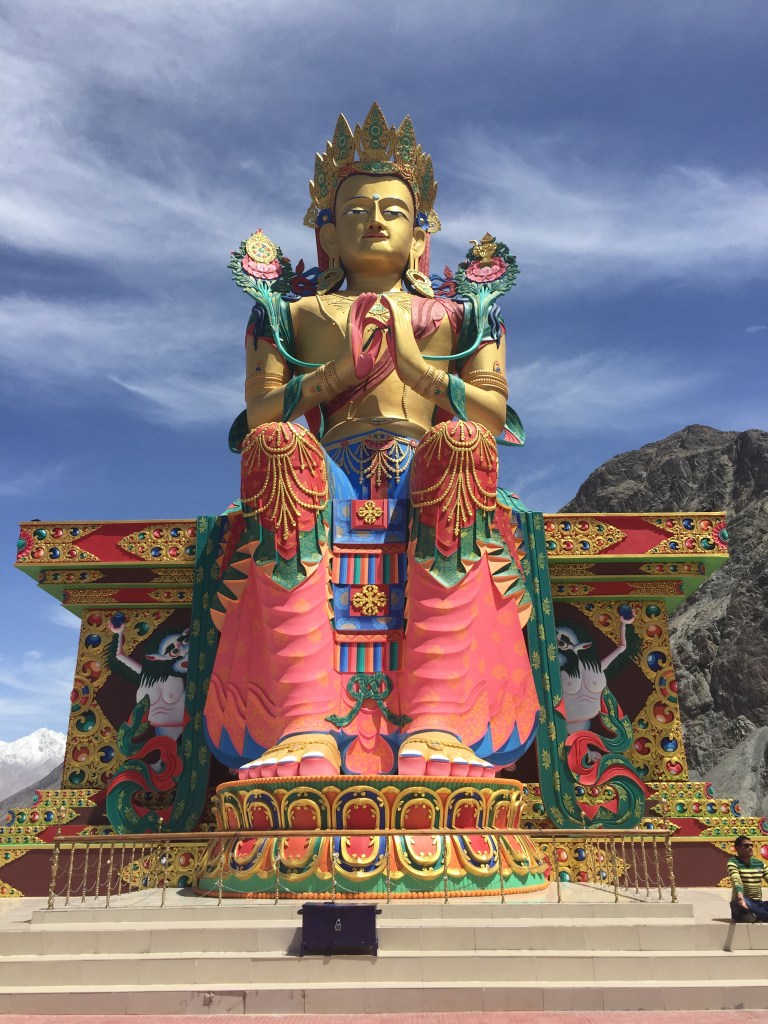
From the hammock, the sky was an oscillating, blue-green leaf-filigree as the morning rays gently warmed the tree trunks and rested on scattered patches of grass. A Magpie dapper in its black and white plumage hopped about in search of juicy insects that were out after an unusual morning rain. A nimble Rose Finch sidled up an Apricot branch in blossom. The benign Buddha was truly alive. It was from this placid valley beyond the mighty Himalayas that connected two of the most ancient civilizations that the Maitreya would arise to resurrect a dying world; a world that was bent on destroying itself. He would re-teach humankind not to succumb to unbridled greed and follow a middle path – any path that was lighted by compassion; based on a minimalism born out of consideration for all living creatures because that was the only pragmatic way. Meanwhile, dark clouds were already gathering over the region.
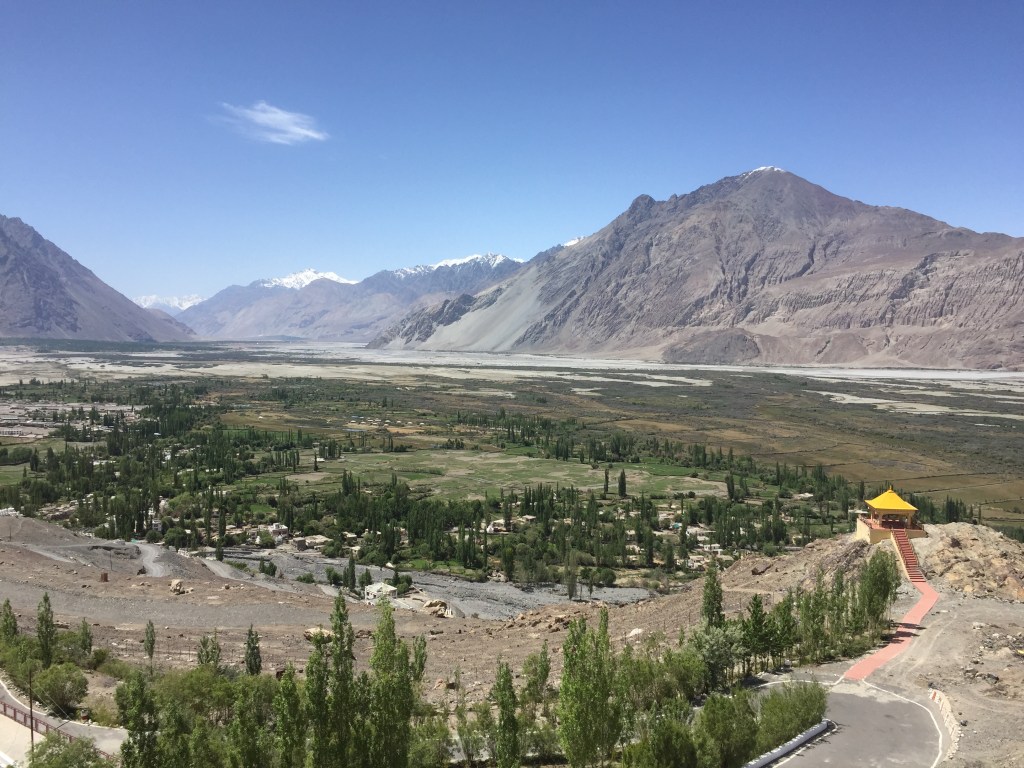
By the side of the hammock tied between two Poplar trees, a small stream filled with fresh snow-melt gushed over pebbles rushing to meet the Shyok that would further downstream, beyond the village of Turtuk, join the mighty Indus. The Turtuk area was recaptured by the Indians during the 1971 Bangladesh war. It was one of the sectors that saw fighting again during the Kargil conflict of 1999. The area was known for its fertile soil and luscious golden orange apricots and mountain-goat-figures with their large, serrated horns that curved all the way backwards, sculpted by village artisans from a locally found grey stone. A tradition that seemed to continue since when the ancient silk route was still alive across the Karakoram Pass, or maybe even earlier.
With Maitreya taking care of the world, I dozed off and dreamt a life-changing dream. A very large gathering of people bound by faith and devotion had collected from across Ladakh below the towering statue. Some had even travelled from remote villages of Changthang and Zanskar. The forbidding Karakoram loomed, a jumble of edges and rockfalls steeply rising above the undulating sand dunes of the Shyok. A couple of Bactrian camels stood by patiently between the dunes, their mouths working continuously, their handlers on the lookout for children and young couples from the plains.
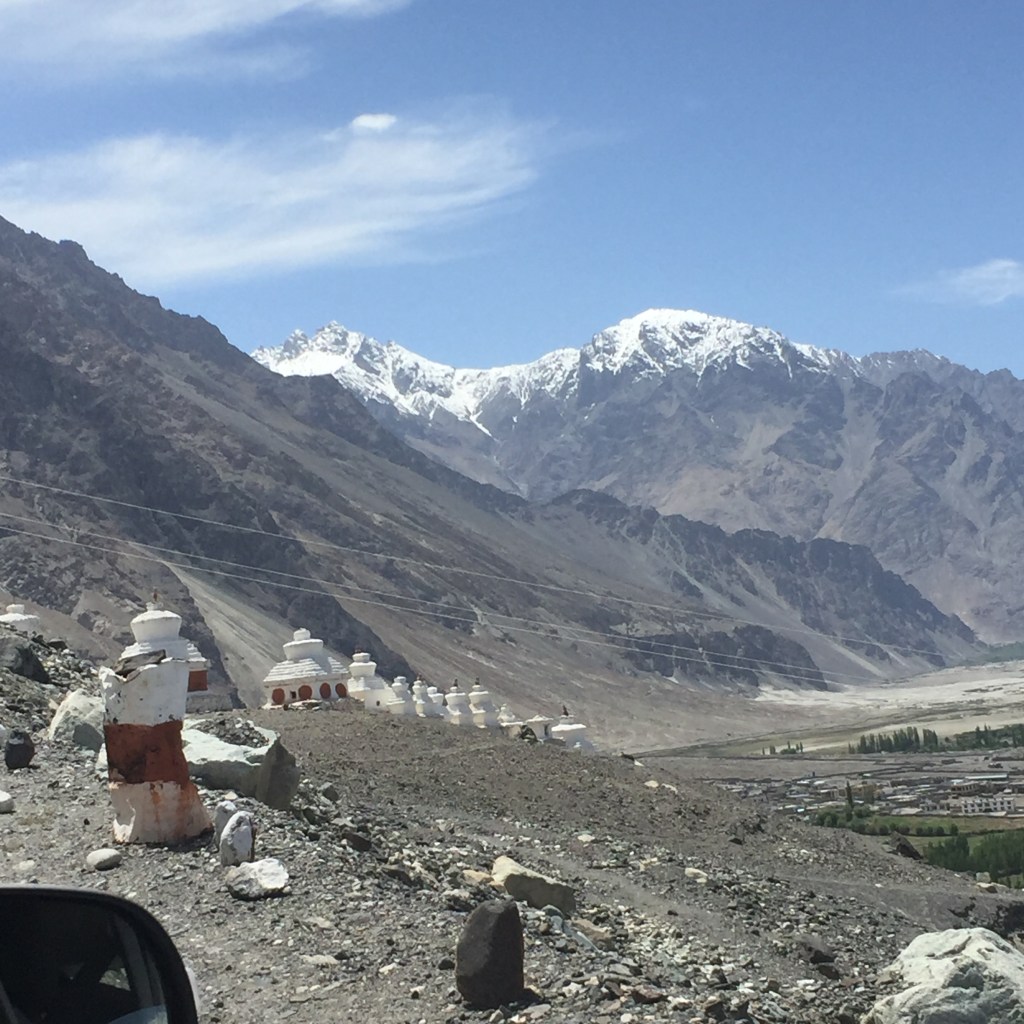
I was standing right at the back of a bright, animated sea of maroon-and-yellow set against a stark landscape. My hands thrust deep into my jacket’s pockets as the shadows lengthened and a cold wind picked up swirling sand grains in shifting verticals. In front, his Holiness the Dalai Lama was sitting on a wide, low stage covered with carpets of different shades patterned with fire spewing dragons that didn’t look dangerous at all. He was talking about the Tibetan scriptures – how some of the rare manuscripts were translated by his friend Jaganath who lived in the ancient city of Varanasi. Dalai’s kind, smiling child-like face was radiating warmth, his eyes twinkled. The audience was greedily soaking in the infectious smile, forgetting their daily hardship and grind to eke out a living in an austere part of our planet.
Then something strange happened. The Dalai pointing at me called out loudly “Noh! Brother!”. And beckoned me to come on to the stage as if he knew me since ages. I was startled and scared. Everyone turned around in unison like a machine to stare in disbelief, but however hard I tried my feet wouldn’t move as if they were chained firmly to the ground. The Dalai was now beckoning fervently but I couldn’t move my feet at all. I was sweating profusely. People still stared blankly and then with growing hostility at my disobedience.
A lifetime elapsed. Then the Dalai laughed a hearty laugh and the shackles were broken; I was walking swiftly towards him.
As I draped a silk khattak given by my mother around the Dalai, he asked me to sit down beside him patting down the cushion. And then holding my hand in his, he said, “Sonam, I want to tell you something”. I suddenly felt very important. Thousands of eyes were trained on us. A man came and poured Kahwa in small Chinese cups kept on a row of Choksas in front. The tea carried slivers of almond and the fragrance of saffron from the vale. These ubiquitous tea cups were smuggled and traded across the India-China borders. The wind outside the tent had dropped its pace as if to listen. A full moon hung low in the sky making the snow on the higher peaks luminescent. An expectant hush fell over the gathering.
The Dalai was saying, “we should have been better prepared. Peace is desirable but too much of it or too much hankering for it debilitates. That is why the Buddha propounded the Middle Path. We should have seen the storm gathering on the horizon and prepared ourselves. We would then have at least a part of the ancient, sacred land with us. Maybe not Lhasa and the Potala, but some other part. Sometimes, I can’t help but think about what could have been. People, they had infinite belief in me. Even today, their belief in me is largely undiminished.” He was talking to me as if I was an outsider, albeit, an empathetic one. “Non-violence is the best way, the most pragmatic too. The world has already seen a lot of violence. But non-violence has to contain within it a core – a core of energy, a strong-enough retaliatory capability. You ignore the surroundings around you at your own peril.” There was a trace of regret and sadness in his voice. Sadness that comes from an irretrievable loss. From helplessness in the face of inevitability.
He was publicly confiding in me his concerns and sharing his thoughts. It was all very surreal. People looked at me with growing respect. Even though they were sitting away from the stage, they could hear it all. Their eyes were moist. The Dalai was saying, “this reincarnation business is turning dangerous in the present context. We need to put an end to it. You must have read about the issue in the newspapers. The Chinese want to determine my successor. Those who don’t even believe in religion want to decide on the next Dalai. To do that what will they follow?” Laughing, “the party manifesto? The people are my successor whether Gelug, Sakya, Kagyu or Nyingma, all. This time we cannot be unprepared.”
Then he changed the subject abruptly or when I look back now, maybe by design. “Sonam”, he said with an urgency in his voice “you need to take charge of this. We need to preserve our common culture. The people of Ladakh are my brothers. Monasteries and Chortens in Ladakh are falling apart. Look at the ones in your village Alchi. In the region of Lahaul-Spiti in Himachal the situation is similar. You go ahead and learn to preserve and, if need be, restore these properly. Scientifically. Learn everything about it in India and abroad and form an army of skilled young volunteers. This time we should be well prepared to preserve history. This saving of a way of living and thinking is as important.” It was uncanny. His words exactly echoed my thoughts. It felt as if he could see the thoughts racing through my head clearly. He patted my head and ruffled my hair playfully. And added, “be a restorer of history so that the coming generations, who may have better sense, can take it to new heights.”
A Magpie dropping splattered on my forehead. In anger, I hurled a twig at the bird sitting high-up in the Poplar; just when I was living my moment of glory. I had heard that a bird dropping on the head was said to be a good omen; nowhere else in the world were omens linked to almost anything that could happen to anyone as in our country. I thought I should tell my dream to my mother. She would be able to interpret its true meaning. Any dream in which his Holiness was present had to be a good omen.
That evening I narrated the dream to my mother. I also disclosed my heart-felt desire to undertake restoration work of old Buddhist monuments in Ladakh; there were many old monasteries and monuments in Ladakh and across the country that needed care. Some of the structures in Ladakh made of sun-dried clay bricks had already turned to dust reclaimed by mother earth and only myths and stories remained. She first looked at me doubtfully, to gauge if I was not trying to make up the dream. Then realising I wouldn’t lie about having met the Dalai even though in a dream she instinctively connected the two – the dream with my aspiration – as I had hoped for, giving my aspiration a sanctity that could not be violated. This was something my father, who wanted me to be a civil servant, couldn’t effectively challenge. The battle was already won. He would, at the most, knowing that the battle was already lost, mildly protest and warn his wife that their son was likely to be a burden on them for the rest of their lives.
Leaving the organic retreat in Nubra, which was still to find its feet in the hands of a relative, we returned home to Alchi village along the fast-flowing Indus to tend to our fields. The village was a terraced green in summers and the winding approach to the old temples and monastery a faux-antique serpentine of stalls bustling with locals and tourists. Summer was the season to earn and save for the harsh winter. My parents also ran an open-air restaurant in their courtyard under the apple and apricot trees advertising their “best pancakes outside the U.S. served with a special homemade Apricot Chutney”. For effect they had also parked an old army green Jonga in the courtyard, gathering dust and dried leaves.
On way from Hunder to Leh, I was again struck by the hardiness of the people living in remote Rebos erected in small valleys on patches of green grass, on either side of Khardungla, at heights above 16,000 feet and the forbidding cold beauty of the area; their Yak herds grazing on the lower mountain slopes looked like tiny specks and their children with freckled red cheeks waved at the vehicles passing by. A big partridge family scurried off the road merging into the rocky scrubland.
Interest in restoration had started two years back in Alchi when a team from the Archaeological Survey of India and INTACH had visited the village. The team was accompanied by an Archaeologist from Durham who seemed wonderstruck by the faded murals and alarmed by their likely loss. He had returned next summer with a group of experts to prepare a restoration plan. Their meetings were held in the courtyard restaurant fuelled by unlimited cups of tea and willy-nilly I graduated from a local guide and translator into an Assistant Restorer, who was asked to sustain the momentum and carry forward the work.
I joined heritage conservation classes in Delhi during the rainy season carrying with me the advantage of practical experience already gained on the ground and a sense of ordainment from a dream I had actually started believing in. That year the monsoons were generous with the city. In Lutyens Delhi, around the India Gate area and the Lodhi Gardens with their old Lodhi era structures, green sprouted everywhere and the roads were washed black asphalt littered with Jamuns. From Delhi, I went to Durham for further studies and then back in Ladakh immersed myself in work.
It was because of the Dalai that I could live a life I had once dreamt of. As time passed, the dream under the statue of Maitreya that had changed my life had receded into the inner recesses of consciousness. Father was no more. He died a happy man, his head resting on my lap gazing at my mother and an old portrait of the Dalai that hung from the mud-plastered wall of the living room. Mother and I continued to live in our home in Alchi; most days I would be away touring across Ladakh. A movement to restore the old structures had taken root and wherever we went the local community’s enthusiasm came as an uplifting wave of surprise. Then one cold winter morning a message from Dharamshala arrived. They wanted me to undertake renovation work at the Tsuglagkhang complex that included the abode of his Holiness the Dalai Lama. I was delighted. I would get an opportunity to meet the Dalai if he was in McLeod Ganj and also gain some respite from the biting cold of Ladakh.
Whenever I would go for a survey or some other work to Tsuglagkhang, mother would accompany me in the hope of catching a glimpse of the Dalai. As days went by her hopes began to fade and she started looking feeble. I sought an audience with his Holiness through his office. It was granted immediately. That evening, after we had offered khattaks, he asked us to sit beside him and holding my hand as he had done more than a decade ago in a dream under the statue of Maitreya talked to us about the photos from his life that were published in the form of a thick, glossy, hardbound book. There were black-and-white photos of the Potala, the stark Tibetan countryside and his escape from Tibet to India. There was one with Pandit Nehru. It seemed he had all the time in the world for us.
At the end of the audience, as we posed for photographs with me and my mother on either side, the Dalai squeezed my hand looking straight at the camera, and smiling mischievously remarked, “Brother, you have come a long way from that moonlit night in the Nubra.” His words struck like a bolt. “I still remember the looming Karakoram and somewhat strangely the fact that the almonds in the Kahwa tasted bitter”, he added. Then he ruffled my hair again. Outside the darkening sky was the colour of Vishnu.
***

 Pankaj's Blog
Please get it published as a short story in any magazine for wider readership. Such a beautiful narration deserves to be shared with many.
LikeLiked by 1 person
Thanks Shaibal! Coming from you that’s some praise indeed. Value it immensely.
LikeLike