
It’s not a type of banana, neither a nutritious root found in the jungles of India that sustained Ram, Sita and Lakshman during their long years in exile. It is a variety of local mango that floods the vegetable Mandis in Varanasi and neighbouring areas of Eastern UP soon after the first summer rains.
Every year, the arrival of Ramkela is awaited with growing anticipation in the ancient city and it disappears from the mandis within a few bustling weeks. In the mandis too, there are known Ramkela sellers.
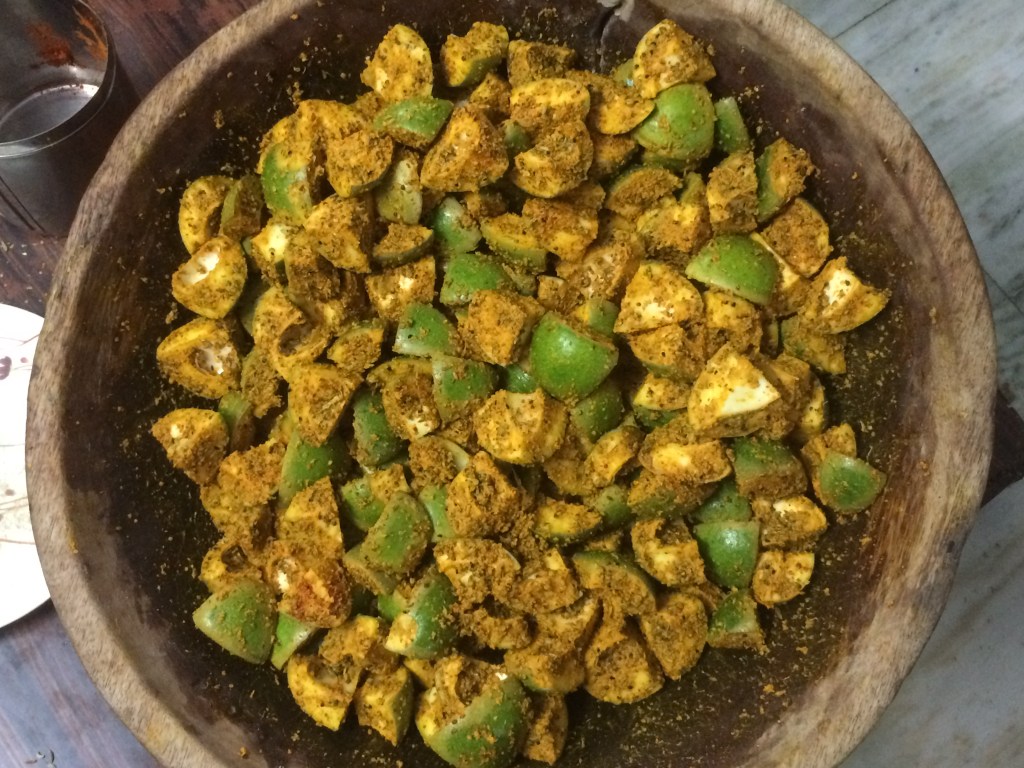
(The picture above is of Ramkela in the making in a wooden Kathwat)
The various stages of preparation: raw mangoes are washed and dunked in water for a few hours, preferably overnight, cut in four or eight parts depending on the size of the mangoes and the seeds taken out; spread on a clean cloth in the sun for a couple of hours to dry, put in a wooden open utensil Kathwat, rubbed with salt (for about 2 and 1/2 kg of mangoes, two fistfuls of salt) and finely ground haldi (turmeric powder) and put out in the sun for a day to dehydrate (the kathota absorbs part of the water that seeps out of the mangoes); a combination of fresh spices is then prepared and evenly rubbed into the mango pieces and mixed in the water left by the mangoes. The spices include: red chilli, yellow mustard seeds both finely ground, fennel, ajwain (caraway seed) and mangrail (black caraway seed) coarsely ground so that some are intact). After the spices are put, a little mustard oil is poured into the mix.
The spice-coated mangoes are again spread out in the sun for a day (traditionally, a wooden chowki covered with a thin cotton cloth is used). Next day, the mango pieces are dipped in mustard oil one-by-one and arranged in a glass jar or Martabaan. A little mustard oil is dribbled over the pieces and a thin cotton cloth is tied on top of the Martbaan so that the mangoes can breathe. The process is nearly complete.
Another three-four days, when the almost-ready pickle is mixed twice a day, and, Voila, you have a tempting, juicy pickle to savour. As the Master Chef team would have said – it’s an explosion of flavours, its rustic, nostalgic and sophisticated at the same time. It truly is.
Reference: ‘Aadhunik Pak-kala‘, 1969, Lekhika – Shail Kumari Tripathi @ Ma.

 Pankaj's Blog
My favrouritist ever!
Slurp…
Thank you for sharing this Munna Mama – right from the “Khaandaani Bible of Cookery”.
Nani rocks!
Ps – I made Guava Jam seeing her recipes ages back and it was a super hit with all my classmates 😁😁😁😁
LikeLiked by 1 person
My fav! 😊
LikeLiked by 1 person
Thanks! Loved writing it.
LikeLike