
Pankaj Tripathi
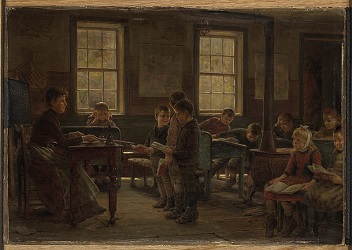
Ms. Pritchard looked out of the dormitory window. On the sandy ground, a level below, a group of boys with feathered headbands was being chased by a group of cowboys. The squared glass panes cut off the sound of intermittent gunfire and arrows swooshing. She could only see them ducking and weaving to evade the bullets and arrows as they whizzed past, and occasionally make a show of galloping. The weekly afternoon Western, based on a Louis Lamour story, in the senior’s hall seemed to have inspired them; she must have watched the wretched film more than a hundred times. Ms. Pritchard smoothened her pastel, floral cotton dress falling around her calves, wriggled her arthritic toes and prepared to go down before the game turned violent.
As she descended the wooden stairs from the long dormitory with two rows of made-up tidy beds to the playground, she saw two boys engrossed in prying leeches from the drain on its farther side. They were putting them in a small, empty Bournvita can. Suspecting that some mischief was afoot – the leeches could be put in the socks or, worse still, underwear of another boy, she quietly tiptoed and stood behind them. The boys, immediately sensing a presence, looked back with half-fearful eyes and saw a glaring, plump, white, freckled lady barely hiding her smile; they quietly shook the leeches back in the drain pushing out the last one sticking to the can’s mouth with a twig.
In fact, it was Ms. Pritchard’s heady Yardley Lavender perfume, the only indulgence she still persevered with besides Cornish Fairings with her morning tea that had alerted them to her presence. Realizing that no punishment was imminent, the more boisterous of the two let out a war whoop and kicked the Bournvita can. The other sprinted after the clanking, tumbling can, throwing on the side an imaginary lasso over a stealthily advancing fearsome Red Indian brave. Meanwhile, as she had suspected, the battle for the American grasslands had degenerated into a slugfest between two overenthusiastic boys. The fight was between a tough Bhutia boy, who was having the better of the exchanges, and a boy from the plains. When a stern command did not do the trick, she had to physically pull them apart with help from some other wards.
As Warden of the young boys’ dorm, they said she had the toughest job in the British-era school, built in the late 19th century above the hill-town among tall pine trees. Keeping the little devils in line was quite a task and required full-time commitment and a sharp nose to sense trouble. The bell for supper sounded and the boys trooped off the field to the dining hall below the dormitory. As their animated conversation receded, she followed slowly, savouring the first sharpness of the approaching winter. After another month, it would be time for the Puja holidays. The mist was already rolling-in from the side of the medical ward hidden behind three huge pine trees called the ‘Three Sisters’, and spreading across the field. It might rain again today, she thought, probably the last of this monsoon. It had been happening every year and every term like this for the last thirty years – towards the end, she would start looking expectantly for the holidays to begin and the respite and the quiet that enveloped the school, and towards the end of the break eagerly wait for the voices to return.
Evelyn Pritchard had joined the school when she was an energetic, petite twenty-year-old, daughter of a decorated British Army officer, who was believed to have died of a stomach ailment while serving in the Kosi river area, which was then known as Kalapani. It was 1945, two years before India’s independence, and the students were largely from British and Anglo-Indian families serving with the Bengal government. Soon after Nehru’s ‘Tryst with Destiny’ speech, her mother and aunt had left for Britain, but she had stayed back resolute, stirred by the promise of a new dawn and unable to let go of the mountains and her wards. She then taught English to the lower classes and did a lot of miscellaneous organizing work.
As could be expected, within a decade of India’s independence, the composition of the students in the school had changed dramatically with hardly any British boys left; their places taken by the local Nepali, Bhutia and Lepcha boys many of whom were not boarders and a few boys from Bengal and Northern Bihar. The number of Anglo-Indian students also gradually dwindled. Likewise, with the British teachers. Some of them never returned from their holidays back home. Months later the Principal would receive letters regretting their inability to continue as after the Great War, the motherland needed its sons and daughters to rebuild. But in almost all the letters Evelyn read and re-read in the Principal’s office, she detected a sense of longing for what they had left behind.
In the 1950s and the 1960s, she too had intermittently wrestled with the thought of going back home to Cornwall or to a new, post-war London, but could never really push herself to do it. She would visit her mother and aunt almost every year for a month or two during the long winter breaks but would always come back to the school in the mountains postponing the decision to leave her adopted land. They understood her; she was cut from a different cloth they said laughing – half strange and half saint. She had taken after her father half-wild they said. But she knew there was something else she couldn’t fathom that bound her to the place. Maybe she was a Lepcha in her previous birth seeking out an unfulfilled dream or illicit love? Both her mother and aunt had settled in the bustling, fishing town of Fowey in South Cornwall. On her visits, they would, along with her aunt’s young daughter Ebrel, who would listen to her ghost stories from the Indian mountains with rapt attention, go for leisurely boat rides from the nearby cove and for picnics along the pretty coast.
Ms. Pritchard had started going back to Britain less often after her mother died; once in two or three years. There was less to go back to as things seemed to change on each visit. With time, her aunt too had become feeble and seemed to be losing interest in the various small things she used to be engaged in. She herself was nearing fifty and found long travels arduous. Her main attraction now being to meet her cousin sister, who had grown up into a sensible, young woman working at a Museum in the town and looking after the cottage and the small garden. Ebrel still seemed enchanted by the stories of the school in the mountains and the people there and enquired after the little boy she had met during her only visit to the school. They both religiously exchanged long letters on a weekly basis – their bridges to another world. That day as she entered the dining hall, the familiar smell of supper mingling with the babble of a hundred excited voices and the clinking of cutlery assailed her like a comforting, warm blast as on all evenings when the school was in session. Supper was the usual fare, laid out on white damask-covered three separate long tables – one for the pork and beef eaters, one for the more modestly non-vegetarian lamb, chicken and fish eaters and one for the vegetarians who made do with vegetables and eggs. A peppery smell hung in the room like a low cloud. She sat down next to Aman on the vegetarian table nudging his elbow as he focused on spearing three boiled peas at one go. One of the peas flew out at an angle and struck a boy’s cheek on the next table. The boy was startled and, amidst the general suppressed mirth, glared around angrily ready for a fight but then he saw Ms. Pritchard and quietly went back to tackling his meal.
She told Aman that his parents had written to the Principal that they would be picking him up from school a few days after the Durga Puja holidays started as they had some urgent work to attend to, adding with a wink that the Principal had asked her to personally look after him. At first, Aman appeared crestfallen but then he smiled. Despite her strict aura, he liked Ms. Pritchard immensely and trusted her enormous good sense. Hearing this, one of the boys at the table conspiratorially warned Aman that as he would be all alone for almost a week, he should be very careful of the ‘Headless Ghost of a White Boy’ that walked in the woods nearby. Seeing the corridors empty, the ghost might be tempted to sneak in. He went on to add some sincere advice: “you should always carry a stout stick with you.” Aman had heard the story before as had every ward of the school and instinctively looked at Ms. Pritchard but she was busy with her food.
That week in early October was the most enchanting of Aman’s life. His things were shifted to the first bed in the dorm closest to the Warden’s room. Ebrel had come over for a visit and the three of them would go for long treks in the forests every day picking berries on the way and resting in between on the rocks with mugs of hot coffee and fairings and chocolates from London that came in all shapes wrapped in crinkly red and blue foils with silver stars They even picked leeches from the rainwater drain adjoining the playground putting them in a glass jar and played Hop-Scotch though Ms. Pritchard was no good at it. She would teasingly warn him not to tell the other boys about the leeches and the games otherwise they would think he had gone crazy in the head after seeing a ghost. They never did see the headless ghost, but Ms. Pritchard told them the sad story of the ‘Three Sisters’, who loved each other so much that they never wanted to leave their parents’ house. The house was situated where now the medical ward and the dispensary stood. Seeing them go against the social norms, the Gods were filled with wrath and they were turned into trees rooted to the place they never wanted to leave. Their poor parents left for the plains thinking the place to be haunted.
Meanwhile, Aman was bewitched by Ebrel – her sparkling eyes, talk of Cornwall and the sea and most of all her laughter. And when one afternoon, he saw his parents alight from an Ambassador car to take him home, for the first time since joining the boarding school he didn’t breathlessly rush to meet them. The last he remembered of Ms. Pritchard was her patting him on his head and saying, “You can be a little naughty sometimes, don’t always have to be good”. And Ebrel smiling… waving. Aman never got back to the school until a couple of decades later as his father had been transferred to another project in a far-off area.
The fire in the junior section dorm fortunately broke out during the winter holidays when no children were around. Ms. Pritchard was alone in the huge building when she smelt the smoke and then saw the flames. She quickly collected a few photographs and clothes and rushed down to ring the dining hall bell. By then there was commotion all around and the flames were rising, almost touching the surrounding tree tops. By the time the fire tenders arrived from the town below and the neighbouring towns, the red tin roof had collapsed and all the timber used in construction burnt down. Ms. Pritchard was shifted to a small quarter on the campus next to the chapel, which had been in a state of neglect for the last few years, and died a year later reclining against the trunk of the eldest of the ‘Three Sisters’. She was buried next to her father on a hill slope nearby surrounded by tall trees.
When Aman heard of the fire through one of the old students, learning with great relief that no one had died in the accident, he was posted at the Army Headquarters in Delhi. He made up his mind to go immediately and help out in whatever way he could and meet Ms. Pritchard if the old lady was still there, but his work and other responsibilities wouldn’t let him. By the time he managed, his old warden had been laid to rest looking up at her favourite bit of sky. On her grave, on which appropriately moss had started to grow and a fern had taken root, was inscribed: “she lived torn between two worlds, but loved these hills and forests more than anywhere else.” As he laid her favourite wild daisies at the grave and sat remembering Ms. Pritchard, thinking who would have written such an epitaph, he heard footfalls coming down the slope. It was not the headless ghost but a woman coming down towards the grave, the face looked somewhat familiar … from another time … there were a few more lines …, but she didn’t seem to recognize him. How would she, and politely asked: “an old student?” He nodded and remarked: beautiful epitaph, describes her just right. She smiled acknowledging the compliment. The children’s voices from the lower ground had fallen silent and a stiff breeze picked up making the pines above rustle in the fading light.
♣♣♣END♣♣♣
https://museindia.com/Home/ViewContentData?arttype=fiction&issid=98&menuid=9607
(first published in Muse India – Issue 98 (Jul-Aug 2021)Fiction)

 Pankaj's Blog