
Hiraman’s first vivid memory was of a grinning Jaglu lift his mother from behind and swing her around, her excited laughter circling, bouncing off the shiny-wavy Aluminium walls. He had never seen her happier than those days, when she would wake up in the mornings lazily doing her hair, eyes lost, smiling before shaking Jaglu awake. They lived in a corrugated settlement scattered atop an abutment overlooking the dam site. Everything about the ramshackle, glinting-winking settlement seemed transitory. They didn’t know then so would be their happiness.
From the tin settlement, Hiraman could see the river flow quietly in the searing heat. In parts it appeared almost unmoving, gazing back at the sky, prescient; water-marked boulders marking its farthest rainy-season expanse, on the far bank trees hanging over, their leaves caressing the water, a little upstream – a small clearing where Jaglu had shown him one moonless night the glowing eyes of a tiger. Now, whenever he looked at the clearing, he half anticipated to sight a tiger. But above all, loomed the giant Batching Plant – a huge stone crusher and mixer combine – towering by the riverside churning out tonnes of concrete that, ferried by dumper-trucks and labourers, piled up like a phalanx relentlessly advancing towards the river.
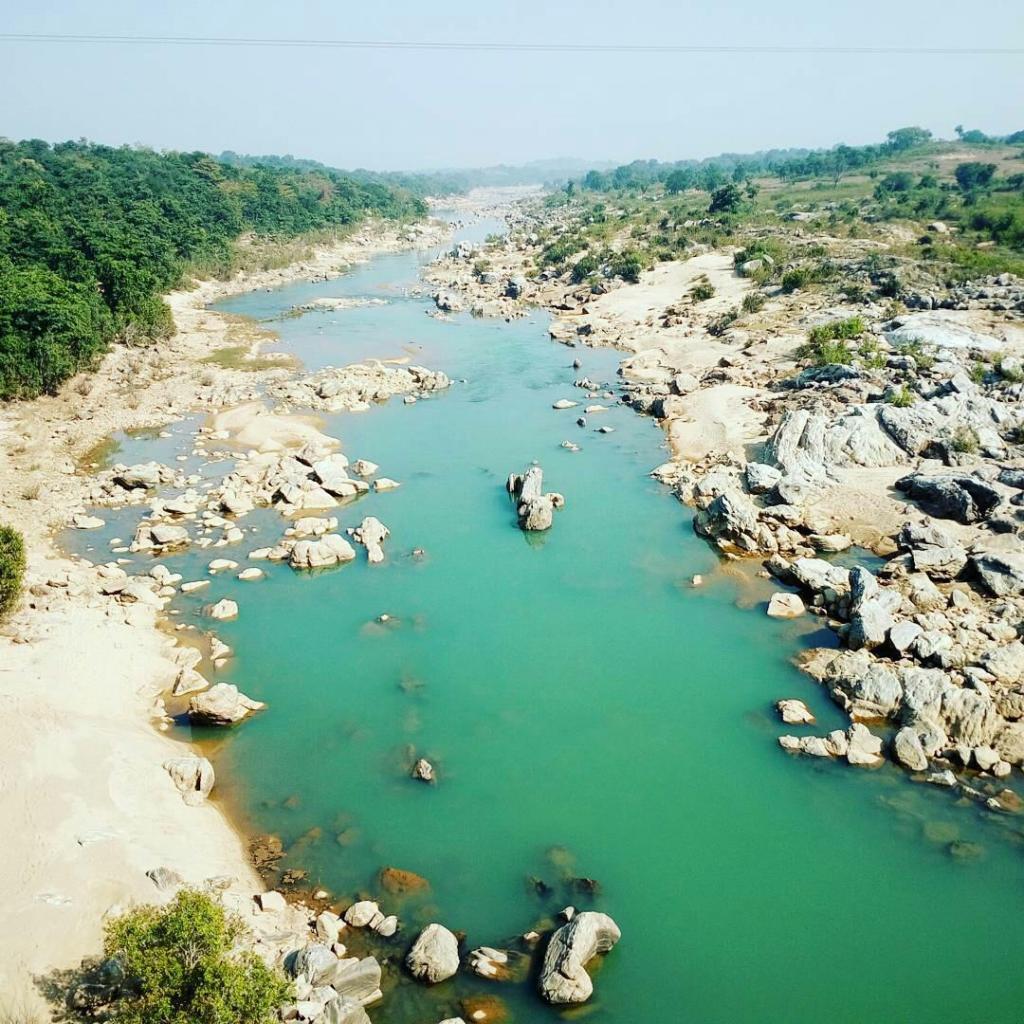
On burning summer afternoons when life stood still, he could still hear the loaded trucks labouring up the inclines and the excavators cutting into the surrounding green relentlessly unveiling a red-brown earth. The margins of human-forest interface were clearly marked by a red-brown and dark green boundary around the construction site. A modern progressive India was getting built but inside many, old ways and entrenched instincts still reigned.
In the mornings, Sunita would hurriedly push big mouthfuls of Roti mixed with Gur or sugar and warm cow’s milk down his throat. He loved the smell of the slightly burnt Roti which would seep into the warm milk and the sugar grains left at the bottom that he could lick. Then they would race down to the dam site along a narrow, winding, dirt path catching hold of clumps of grass and protruding root-tentacles, exposed by a million dreams, to break descent. The dreams had largely dissipated, replaced by a creeping cynicism and acceptance, but ideals and hope still sprouted in pockets of the ancient land.
Then Hiraman would be set free with a pat on his head. He would immediately clamber up his favourite rock and occupy its summit. It made him feel like a king. It also provided a vantage point to cover both the approaches to the site and look at a wide arc of the river. And when he turned, he could see the sloping wavy metal roofs of the settlement that blinded the eye. The rock-throne had a small crater with a shallow puddle teeming with life. Algae, water beetles and tadpoles that he could chase with a twig while following his mother as she carried the concrete mixture piled on a tagaadi, resting on a small piece of coiled cloth on her head, to where Jaglu worked weighing-down on one of the huge vibrating machines to shake the trapped air out and make the concrete settle firmly. Victory of the inorganic over the organic, at least for the time being. Jaglu would see Sunita and grin. Always, grin and wink. They were married for four years but she was like a lover he was ever trying to please. Such love would not have survived a more complicated life.
There were a few hundred workers, both men and women, labouring in shifts heralded by sirens. Most of them were from the local tribes, though the contractors and sub-contractors recruiting them were from the plains. In summers, work would go on the whole night and in the mornings till eleven when the blazing sun turned so hot that people would start fainting, and, if anyone touched a boulder by mistake, the granite would take the skin off. From his throne, Hiraman could hear the calls between the workers and the work-gang leaders and bits of banter and laughter and abuse.
Hiraman was still scattering tadpoles desultorily when his friend Kisan clambered up and sat beside him snatching the twig and throwing it away. Looking at him, Hiraman asked: “what happened?” Kisan: “same, salaa…last night, he stumbled home very late, must be early morning reeking of tharra, and slapped mother when she complained. She hit back harder and they quarrelled for a long time until the neighbours came around. When he is so drunk, he is no match for her. He is still sleeping in the house snoring like a pig; they’ll throw him out mother says. We may have to go somewhere else.” Hiraman put his arm deliberately around Kisan’s shoulder reassuring him as Jaglu comforted him when he was unhappy. “Let him go. You and your mother can stay with us, it’ll be great fun. Chalo lets go to Sardarji and get our toffees. From there, we can go on our riverside expedition to collect cheez (things) for our treasure.”
The burly crane operator Sardar Singh was Hiraman and Kisan’s best friend after Jaglu. He had been trained to operate the crane long back by a German Engineer in one of Pandit Nehru’s ‘temples of modern India’ multi-purpose projects. He was also an experienced mechanic, who could fix malfunctions in the huge machine and other site equipment. The crane and excavator operators and truck and bulldozer drivers and mechanics revered him and sought his help whenever there was a problem they couldn’t handle. To humour him, they had named the common Mechanical Wing mess Sher-e-Punjab Dhaba – borrowing from the most popular Dhaba name across the country – complete with a badly-painted picture of a Rooster that resembled more a fat Turkey. The Sher-e-Punjab Dhabas were an inadvertent ode to the robust earthy food of Punjab and its intrepid truck-drivers. God didn’t make people like the Sardarji anymore Jaglu used to say.
In Sardar Singh’s spartan tenement at the site, the only decoration was a framed photograph of his family kept in an alcove. His wife Jaswinder and their two daughters Gurpreet and Jaspreet lived in a village near the Tibri Cantonment in Gurdaspur district. Seeing the two approach, Sardar Singh slowly shook his head and showed an empty pocket. The supplies from the district headquarters were late as flash floods had washed-away a small bridge across a barsati Nullah. “Kal do-do lemonchoos milengey puttar”, he shouted over the incessant din as he worked on the roof of the tunnel, in which the water-operated turbines would be housed.
For Hiraman and Kisan this was the most exciting part of the day; of which they would think of as soon as they woke up. Walking by the river, hand-in-swinging hand, sometimes arms over each-other’s shoulders, venturing out on their everyday expedition of discovery, adventure and accumulation – collecting odd things. After each expedition, they would take stock of their ‘treasure of things’ and feel a sense of fulfilment. It was also what they dreamt about. The night Hiraman had high fever due to Malaria and had become delirious, he had a frightening dream of desperately trying to climb a wet, slippery cliff above the river with the treasure box in one hand and falling, his hands slipping off the edge even as Kisan tried to hold him from above. He had sat up with a whimper; a very tired, half-asleep Sunita and an anxious Jaglu patting him back to sleep.
It had grown to be an obsession.
They would remember the time spent by the little river decades later, when they would again be together in the days before Kisan’s death. (That is another story to be told.) It was uncanny that in the last few days before he died when most of his memory had dissolved, Kisan remembered little details of these childhood years spent with Hiraman and the odd things that made up their treasure as if these moments of being alive had etched themselves deep inside his mind. Even as the outer layers peeled off and fell by the wayside as the end of the journey approached, the core with its trivial memories remained: Once, Kisan had picked up a brown shell from the river-bed and a small silvery fish had slipped out plopping back into the shallow water. Once, a Kingfisher had swooped down-and-up, a blur of incandescent-electric-blue with a fishtail quivering in its boaty brown beak. And once, they had watched a snake warm itself on a rock on a lazy winter afternoon only to be devoured by a huge Goh monitor lizard in a squirming frenzy.
Hiraman and Kisan had a Goh tail in their treasure. It was one of the prized possessions, as they had heard stories about these tough-looking creatures with their powerful whiplash tails. How the big ones were used by Shivaji’s soldiers, ropes tied around their strong reptile bodies to climb up sheer fort walls in the dark and attack a surprised enemy. In many parts of the country, their fat (Saanda Tel) was believed to contain aphrodisiacal properties. In the smaller towns, a not-so-thriving Saanda-tel business continued to be peddled with its benefits for masculine stamina being extolled over loudspeakers from dusty, stained tents near train and bus stations. And a white turbaned man with a big curling moustache slyly urging passers-by to try it once to experience first-hand the earth-shattering impact.
Kisan had once told Hiraman a hilarious incident about his father, who had surreptitiously brought a small oil-bottle from the nearby district town bus-stand imagining a whimpering, lusty, obedient wife in the wake forever his slave. That night Kisan had been woken up by a beastly howling as his father rolled on the ground cupping his crotch, while his mother nearly died of laughter. The earth-shattering Sanda tel bottle was thrown as far as he could the next day on the other side of the settlement where all garbage was dumped on a slope, and slid down to rest near the river bed. But for Kisan’s mother, it had become a sharp arrow in her armoury to be used as a weapon against an often-abusive husband.
After the two tired going up and down the river looking for things and hunger started its rumbling, they would sit under a Mahua tree the sweet smell of whose flowers had the power to transport people to another world – lazy and content – or the Palaash whose bright orange flowers in spring would set the forest ablaze heralding the festival of Holi and share a roti. They would talk or lie down looking up at the endless sky and listen to the river flow. Then, only two beings existed in the vast Universe looking at the clouds change shape and felt like God.

The much-storied Mahua (Madhuca Longifolia) tree, sought by Hiraman and Kisan to rest under after their searches, was a lifeline for the villagers and for foraging animals; its cream-coloured fragrant flowers appearing for one night and dropping to the ground just before dawn nourishing both people and animals. The villagers used each and every part of the tree – flowers which were succulent and edible when fresh and the sun-dried ones that turned into a nourishing, smoky, heady drink after fermentation, the green oval fruits and their brown seeds, the slightly furry leaves when young, the grey-brown, fissured bark and the dense reddish-brown wood underneath. And deeply revered it. Ground and mixed with seeds of the Sal tree, the seeds formed a staple for the native people. There is a popular Gond saying – “Heaven is where there are Mahua trees …”.
The usufruct forest rights of the tribal people dwelling in the area for ages, however, had been diminished by the British through the Forest Act of 1927 that had continued in independent India (this old injustice would be partially corrected in the future in 2006). The local gatherers of minor forest produce such as various types of seeds, roots, flowers, fruits, bark and herbs would take their week’s labour to the weekly Haat for sale but the sharp middlemen operating on behalf of merchants in nearby towns ensured that they received a dismal value for their produce. Even though some of this produce formed critical raw material for many pharmaceutical drugs and other products, and their actual market value was much higher.
Near the dam site, in the village of Mandola, under a large Mahua tree, stone images of Bandevta and Bandevi were very old and believed to have healing powers. In the olden times, villagers from far off villages would come to pray and make offerings. Belief in their miraculous powers was, however, eroding and their status in the order of divine beings diminishing following the advent of more powerful and more compassionate Gods of smarter, wealthier outsiders depicted in colourful calendars that hung from the walls of the tiny Paan-Beedi kiosks that had sprouted around the dam site like jungle-mushrooms after rains.
Hiraman and Kisan would often hang around these shops in the evenings enamoured by the older people smoking Beedis and cigarettes. When no one was looking they would collect burnt stubs thrown by the roadside and try smoking these in a secluded spot. One day gathering all their strength, they approached a Paan-Beedi shop. Putting on a brave front, Kisan held out a Rupee casually asking for a packet of beedi for his father. The shopkeeper looked at them appraisingly and handed over a packet muttering from behind a mouthful of tobacco juice: “don’t burn your hand lighting it”.
Hidden from a roadside view, behind the small shops, an insidious Mahua-competitor had quietly sprung up overnight; a bamboo shack selling liquor ferried from the district town. Many like Kisan’s father quickly became regular patrons and were soon borrowing for their weekly tipple. The orange-yellow liquor was hard-hitting and most of the regulars became indebted to the liquor shop owner. The shack also served fried fish and pakoras to its clients, who were watched over by an array of colourful posters of Bollywood actresses cello-taped on the walls. The drinkers felt that their favourite heroine had set her eyes firmly only on him and coveted no one else.
Fights in the shack were regular though mostly harmless and easily disrupted by the servers. Women from the nearby villages, including those working on the project, hated the place and had once complained to the Junior Engineer, but nothing had happened except that songs played on a tape recorder were turned down so as to draw less attention.
Kisan wanted to be like the Bada Engineer Sahab, who came in a Station Wagon and sometimes in a rust-coloured Ambassador car from the district headquarters to supervise the work and hold meetings with the other Engineers living close to the dam site. His round-kind-focused face broke into a smile whenever he saw Kisan staring at him open-mouthed and his quick Gita-driven steps slowed. That day, or the next, all the children at the site would get a special treat of Samosas and Jalebi brought all the way from the district headquarters. They would crush the samosas with their thumb and pour the green coriander, garlic chutney over the steaming potatoes.
A small Engineers’ colony had come up a little downstream from the site, but their children mostly played among themselves. Once a boy, a little older than them, with sad brooding eyes had come in the rust car. The boy was sitting by himself looking bored and eating biscuits when Kisan and Hiraman approached him. He had readily shared his biscuits and they had become friends. Listening to their boastful jungle stories of tigers and bears and elephant herds that passed through the area during their seasonal migrations, their tales of bravery and cunning, about their expeditions along the river and the treasure of things, he wanted to live with them in the tin-settlement. But before any arrangements could be decided upon, the Khansama from the Inspection Bungalow came running as the Bada Sahib was waiting for the boy for lunch.
For the next one month, the boy would come every time the Bada Engineer Sahib visited and in turn told them stories about a school and a hostel in a far-off city where the mighty Ganga flowed. The river was believed to always remain pure though actually all the city-waste flowed into it. He told them that in that holy city the temple bells never stopped ringing and that its narrow Galis (lanes) all of which opened to the river Ganga on one side were dotted with old small temples. But one had to be careful entering these narrow lanes as huge Oxen with pointed horns roamed these Galis. He boasted: “you can even slyly drink Bhaang-mixed Bhole Nath-ka-Prasad, like the heady Mahua, from Purwas kept on Ghat steps leading to the river”. The boy told them about the Ramleelas held in Mohallas across the city during Ramnavmi and what fun it was to be part of Ramchandraji’s vanar sena; and about the Mallah boys who could dive in the river and pick-up coins and swim across the wide Ganga but not in late August-September when the river was swollen and the current terrifying.
Hearing the Ramlila stories, Hiraman and Kisan would pester Jaglu to narrate to them Ram and Sita’s story. Jaglu didn’t know the story well so first he made small bows and arrows for them to play with, and then along with Sunita and Sardar Singh retold Ramkatha that formed such an intrinsic part of India’s soul. The story-telling went on for more than a month and in the evenings the children at the settlement would wait eagerly for the story session to begin. When it finally ended, the most heart-rending part for the children was when an anguished Ram, who had expressed his deepest gratitude to Hanuman for locating Sita, had to ask Sita to leave Ayodhya as some people in the city thought she had become impure living alone in Ravan’s Lanka.
The treasure of things collected during their daily expeditions kept growing as the days went by. It was kept in a cardboard box in a corner of the one-room shelter Jaglu had as Kisan’s father would relish kicking it around after his drinking binges cursing Kisan and his mother. Jaglu, on the other hand, took a bemused interest in the growing treasure even when he was limp with fatigue. He would happily laugh at some of their things and the stories behind them. The day Hiraman and Kisan had found a bear’s claw, Hiraman was gleefully telling Jaglu the story of how they were chased a long way by a swarm of angry bees and Kisan was bit on the ear when Kisan sheepishly walked in with his ballooned ear. Looking at him, both Jaglu and Hiraman had doubled up laughing. Even Sunita couldn’t suppress her laughtter as she commiserated with Kisan.
For Hiraman and Kisan, it was a hard-earned treasure like Silas Marner’s, accumulated a little every day, giving them daily contentment and filled them with a strange anticipatory excitement each night. The trove contained feathers of myriad types including of jungle fowl (Ban Murgi), peacock, parakeet, kingfisher, partridge and quail; porcupine quills; red-and-black Ratti seeds, which were used to measure gold in ancient times; buttons of different kinds including a big brass button with an embossed Queen’s Head (how it came to be in a remote plateau-jungle in Central India would have been a mystery fit for Sherlock Holmes to solve), a one rupee silver coin with King Edward VII’s head long out of circulation, Cadbury wrappers and cigarette foils that still smelt of tobacco, a sharp, curved claw from a sloth bear’s paw (found underneath a tree with long, vertical bear scratch marks), scores of colourfully-patterned dead butterflies and moths, a snake’s diamond-patterned kechul (old-skin) picked up from the base of a thorny Ber shrub, dried Mahua flowers and seeds and a wooden dumper-truck gifted by Sardar Singh. With each thing, a shared story of laughter, fear, wonder and awe was attached – turning it into a treasure of stories, of memories by a little river.
Further downstream from the dam site, about half-a-kilometre from the Inspection Bungalow, the river widened and was joined by another smaller stream forming a large, open, shallow, sandy area used by the villagers and their cattle to ford the river. In the evenings as the sun started setting, cattle herds with their bells tinkling would cross over to the other side disappearing into the jungle, where some ancient villages were located. The stretch of sand burning hot in summer afternoons would mostly be deserted except for a few stray dogs, but in winters, on bright sunny Sunday afternoons, almost the entire workers’ settlement would set-up camp there cooking Rice and Mutton curry, drinking and dancing to Bollywood songs on their radios. Unknown to the revellers, large packs of Dhols (wild dogs) would descend on the opening in the night to chew on the leftover bones.
Work at the multi-purpose project in a small river valley about which the rest of India was oblivious went on at a brisk pace driven by the Bada Engineer Sahab. Days, weeks, months and a year went by and then another and then one blistering May-day there was much frenetic gossip which carried an undertone of impending upheaval. That day, a public announcement, preceded by a long wailing siren, was made by one of the Junior Engineers on the Public Address System installed by the dam site.
The work on the main dam had to be stopped as there were delays in procurements, including the main sluice gates, and the labour force would be cut by more than half before the start of the monsoons in July. Jaglu was confident that he would be retained as his work was liked by everyone and he had got the best worker award many times. However, when the time came and the list of those who would stay back was put out on the Notice Board, Jaglu’s name was missing. Instead, a number of makras who didn’t know anything about construction work and spent their time gossiping and doing teemardaari of contractors and officers were retained, including Kisan’s father.
It was in mid-July, during a break in the Monsoon spell, almost thirty years since India’s independence, that the two friends bid goodbye and reluctantly divided their treasure. Kisan gave the entire treasure to Hiraman as it would remain safe. From which, Hiraman gave him the sloth bear’s claw to protect him. From then on, their lives would follow very different courses – Kisan’s full of struggle ending in a big city and Hiraman’s lonely like an ascending star – only to be together again sometime before Kisan’s death. Then in the Delhi-dusk, they would recall the time spent by the small river flowing through the Sal-bamboo-Mahua forests of the central highlands sitting in Hiraman’s veranda with their drinks; in their eyes, three real heroes of a still emerging and evermore chaotic nation – Jaglu, Sardar Singh and Bada Engineer Sahab stood out and shone the brightest – and of course above all the beautiful, resilient, hardworking Sunita and Kisan’s mother. In their mind, they also thought of the other hoping and half-knowing that the other would put him in the list.
When Hiraman came back to the dam site on a tour as an ADB official nearly three decades after leaving, the prescient river’s flow had been long controlled and a cemented canal had come up carrying water to the fields in the district, where wheat had rapidly replaced coarse grains as the main crop. There were stray incidents of fights over water too and Maoist cadres had slowly gained strength in the region, claiming to “liberate” areas, particularly the more remote ones and the hilltops, seeking to challenge the feudal order and the somnolent corrupt state machinery. Later, they too would get involved in arrogating and distributing patronage and the local tribal people of the plateau would be left wondering, helpless in their poor but tidy villages continuing to rely on the forests and the Mahua tree.
Then the canals started silting and no one paid much attention. Whenever rains failed for two-three consecutive years, the big far-away cities seemed the only salvation for emaciated bodies seeking basic nourishment. Over the years the area saw large-scale migration, with families moving to the state capital, to other bigger cities in the plains and many eventually landing up in the metropolises of Delhi and Mumbai. Some stayed back in their hamlets to plant the hardier so-called coarse grains in what were now wheat fields as the canal water too would dwindle during droughts, and look after the elderly and the infirm.
Hiraman would return one more time on a personal pilgrimage – to immerse Kisan’s ashes in their beloved river and bury their dreams under a lonely Mahua tree.
- For dear Bada Engineer Sahab and the people of Mandola

 Pankaj's Blog