
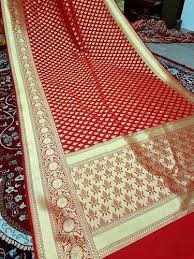
Banarasi Sarees are made of finely woven silk (Resham) and decorated with intricate designs using gold and silver brocade (Zari). The designs are characterized by intertwining floral patterns (Kalga and Bel) and a string of leaves called Jhallar along the border. Other features include – compact weaving, figures with small details, a metallic visuality, intricate Pallus, Jaal (a net like pattern) and mina work. These Sarees are usually worn on special occasions such as weddings and also form a part of an Indian bride’s trousseau.
There are four main varieties based on the type of material used – pure silk (Katan), Organza (Kora) with Zari and silk, Georgette and Shattir. According to design features, the well-known types are: Jangla, Tanchoi, Vaskat, Tissue and Butidaar.
(Source: Google Images)
Background:
The tradition of Silk Saree weaving in the city of Varanasi and the surrounding areas is old. According to some accounts, it dates to the 16th – 17th century. However, some of the earliest mentions of the brocade (Zari) textiles of Banaras is from the 19th century. With the migration of silk weavers from Gujarat during the famine of 1603, it is likely that silk brocade weaving started in Varanasi area in the 17th century and developed further during the 18th and 19th centuries.
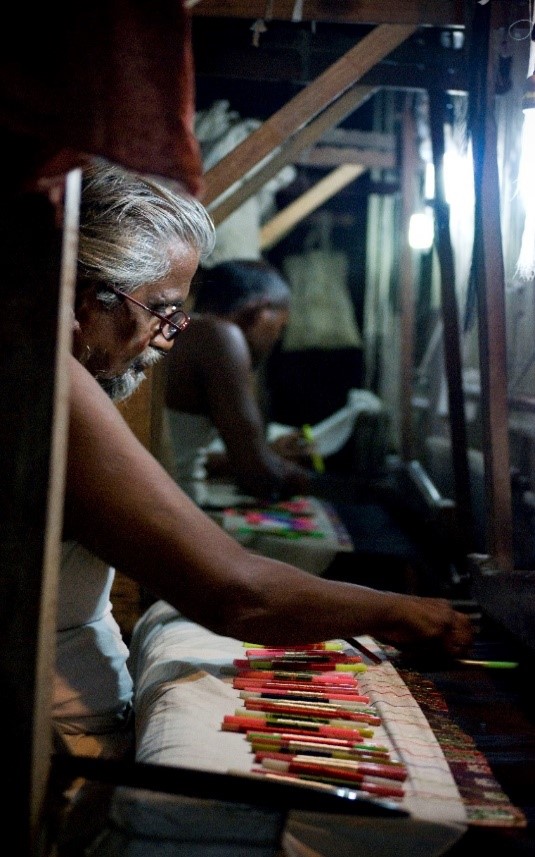
Saree making is a cottage industry in the Varanasi region (it includes pockets in the nearby districts of Chandauli, Jaunpur, Bhadhoi, Gorakhpur and Azamgarh) and directly or indirectly provides employment to more than one million people.
Geographical Indication (GI) Rights
In July 2007, nine organizations – Banaras Bunkar Samiti, Human Welfare Association (HWA), Joint Director Industries (Eastern Zone), Director of Handlooms & Textiles Uttar Pradesh Handloom Fabrics Marketing Cooperative Federation, Eastern UP Exporters Association (EUPEA), Banarasi Vastra Udyog Sangh, Banaras Hath Kargha Vikas Samiti and Adarsh Silk Bunkar Sahkari Samiti – applied for GI (Geographical Indication) rights. The move was supported by the United Nations Conference on Trade and Development (UNCTAD).
In 2009, GI rights for the ‘Banaras Brocades and Sarees’ was secured. As per the GI certificate, Banarasi products fall under four classes, namely silk brocades, textile goods, silk saree, dress material and silk embroidery. Most importantly this means that no saree or brocade made outside the six identified districts of UP (mentioned above) can be legally sold under the name of Banaras saree and brocade.
Most of the weavers of Banarasi sarees are Ansaris (Muslims) living in localities like Jaitpur-Chhora, Madanpura and nearby villages of Sarai Mohana and Mubarakpur while the wholesalers are largely Hindu traders largely concentrated in the labyrinths of the crowded Chowk and Godowlia areas.
Issues:
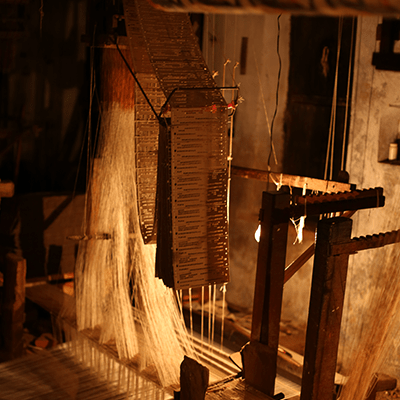
These Sarees are either made on handlooms or on power looms. Till recently, erratic electricity supply in the area had adversely impacted the industry as Sarees could not be completed in time thereby affecting earnings. However, the power supply position has improved in the past few years.
Look alike Sarees some even made in China using plastic threads selling at cheaper rates have also affected sales.
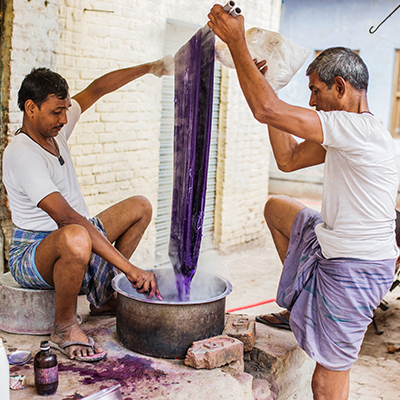
Chemical dyes are used by a number of silk dyeing units increasing the level of water pollution in Ganga and its tributaries. IIT BHU has been pioneering a project to promote the use of natural dyes that are extracted from plants such as Acacia, Palaash, Marigold and Pomegranate (Anar).
(Source: Google Images)
The introduction of GST has impacted this cottage industry – both weavers and wholesalers. However, its impact is expected to reduce as the old traditions and structures adjust to the new ground reality.
(Source: Google Images)
Product diversification:
The industry has seen significant product diversification in recent years with the growing importance of products like silk scarves, stoles and items such as table-runner and pillow-cover for sale both within India and for export. A number of NGOs and business groups like the Taj group have extended support to the weavers. This link needs to be strengthened so that there is an ongoing exchange of ideas between the world of the weavers and traders and organizations and institutes that are involved in design and marketing.
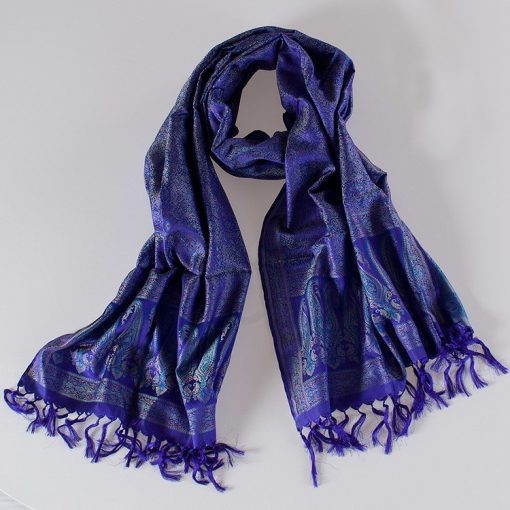
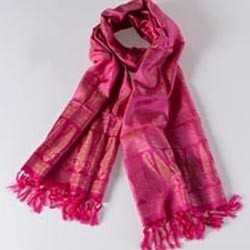
(Source: Google Images)
Conclusion
Use of innovative techniques such as for efficiently extracting natural dyes and better working facilities (airy and well lighted working spaces) for the handloom weavers would go a long way in sustaining this valuable cottage industry and the communities associated with it. Also, an ongoing exchange of ideas between the weavers and the design institutes would add a new dynamism to this glittering intangible cultural heritage tradition of Varanasi.

 Pankaj's Blog